
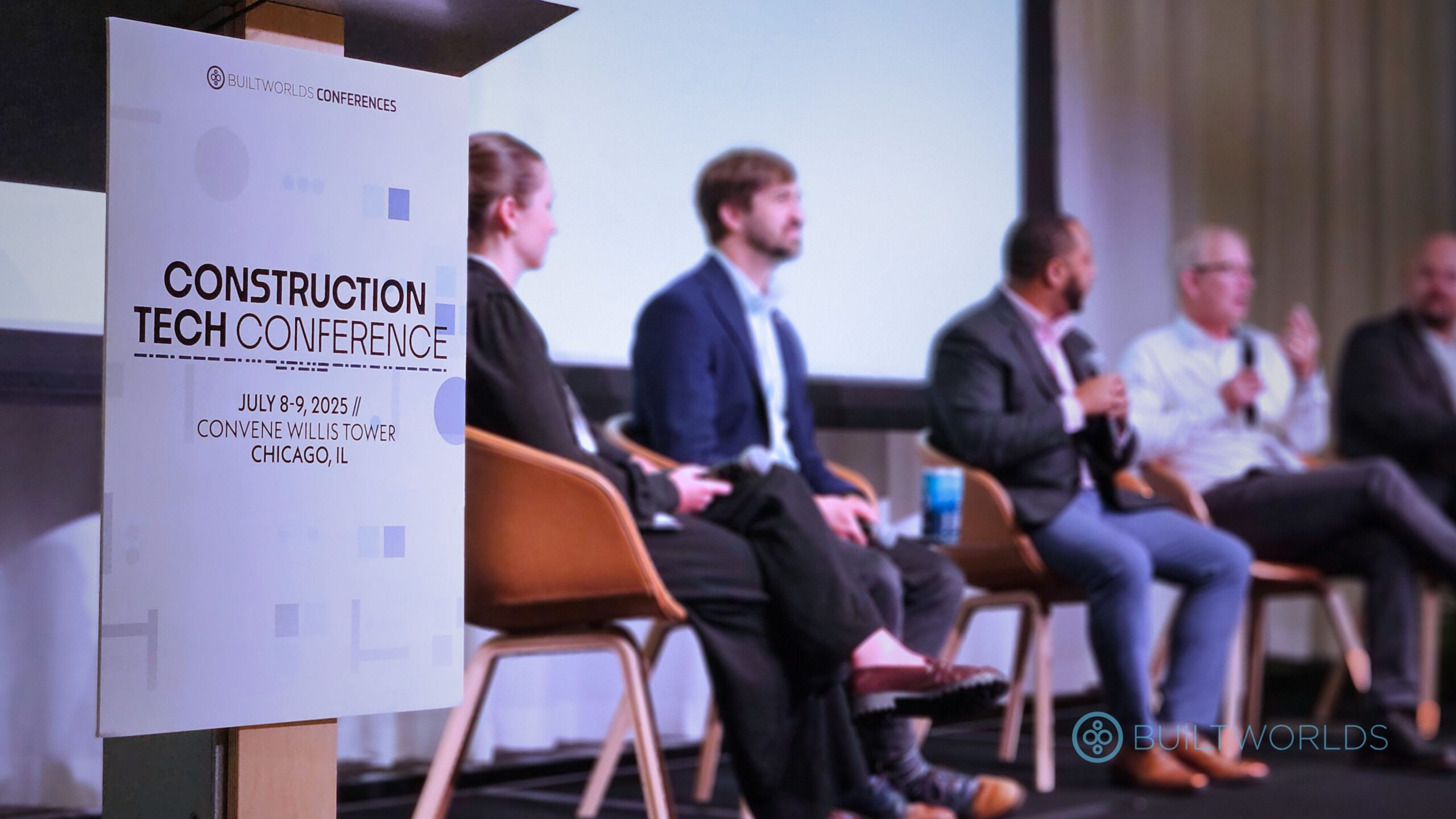
The 2025 Construction Tech Conference by BuiltWorlds attracted more than 300 industry leaders, innovators, and stakeholders from more than 225 different companies spanning the globe and building and infrastructure value chains. It was the most well-attended Construction Tech Conference since the event’s inception more than five years ago.
While the conference was a conglomeration of experiences—including networking and receptions, closed-door working group sessions, a Demo Day Competition (won by Drawer AI), and the inaugural Contractor’s Choice and Tech Excellence Awards—at the heart of the event was rich, focused content, stemming from BuiltWorlds’ research. For two days, thought leaders from throughout the industry took the stage to present insights and discuss the finer points of a range of topics central to this year’s theme: augmenting individual performance with today’s technology.

While the lessons imparted during those two days (as well as the day of closed-session working group meetings that proceeded them) are too many to lay out in a single article, we have collected a number of the key takeaways for your review below.
1. Opportunities Abound for Improving Performance. In Burns & McDonnell Chief Innovation Officer Matt Olson’s keynote address, he emphasized that while the construction industry faces inherent challenges, like fragmented worksites and complex supply chains, there are significant opportunities to improve efficiency through better information management, automation, and AI-assisted simulations. Olson shared examples from Burns & McDonnell including automated pile drivers, direct design-to-fabrication steel production, and AI-powered supply chain risk analysis that have saved $40 million in potential delays. He stressed that successful innovation requires building trust, standardizing data, creating reusable code libraries, and maintaining human oversight while using AI as a tool for running scenarios rather than making autonomous decisions.
2. Sustainability Requires Holistic Action. In a session in which leaders from Pepper Construction, VINCI, and Kajima shared their respective company’s vision for a “greener future,” we heard about approaches to sustainability that included multi-pronged approaches incorporating a variety of cleaner technologies and dedicated strategies. Pepper’s Juanita Garcia talked about systematically reducing carbon emissions through solar and carbon-infused concrete. VINCI’s Louis Cotton discussed their threefold sustainability strategy focusing on climate action, circular economy, and biodiversity, with goals including 40% carbon reduction by 2030. And Kajima’s Dai Ohama presented on the company’s environmental vision that had goals set beyond 2050 and emphasized carbon-negative concrete development, forest asset management services, and innovative renewable energy projects like geothermal power and urban wind farms. The group agree that government policies, customer education, and cross-industry collaboration were key to ultimately advancing sustainability in construction.

3. AI and Automation Will Be an Impactful Pair, Especially in Vehicles. Artificial intelligence and its role in improving and expanding the capabilities of automation, across software as well as machines, was a central point of conversation throughout the conference. It was said that the industry is reaching an inflection point for scalable autonomous technologies. This was especially seen to be true as it relates to vehicles. Experts from Gravis Robotics, Kubota Canada, and Blue Light Machines agreed that improved sensors and drive-by-wire systems are enabling truly practical implementation of autonomous equipment. Though, the group warned that the safe flow of data and cybersecurity overall should be a serious consideration for the industry as we continue to embrace these advancements.
4. Innovation in the Field Happens Through Enlisting the Support and Input of Field Professionals. Innovation adoption and implementation is well known to be difficult when it comes to field staff, who are often too busy and preoccupied to learn new technologies (even when they may ultimately improved their output and quality of life). Still, there are strategies to ease that transition in the field. In a discussion between insiders from Granite Construction, Fieldwire by Hilti and Gammaer, we heard insights into those strategies. It was recommended that innovation team work with superintendents, who can help drive change, and look for quick wins to demonstrate value. The panelists discussed the importance of having a supportive framework for introducing new technologies, including dedicated construction technology teams and onsite support. And finally, the group emphasized the role of balancing the number of apps and tools on the jobsite, being careful not to overwhelm teams with new tech, and prioritizing integration between systems.
5. Measured Success. As exciting as innovation is, especially in a historically analog industry, a common thread throughout the event was not to over-indulge in technology just for the sake of feeling tech-forward. Measuring the impact and progress of the systems and tools through data-driven metrics and ROI is important and key to long-term success. In a session on harnessing disruptors, leaders from Mortensen, R.G. Construction, EllisDon, and Doxel specifically mentioned quick payback periods (ie, 1-3 months) for technology investments, the value of references over pilots, and the importance of having data you can trust (and trusting that data).
This year’s Construction Tech Conference was BuiltWorlds’ most successful yet. But 2026’s event will be here before you know it. Register your interest today to get early updates on tickets, speakers, and scheduling.
Discussion
Be the first to leave a comment.
You must be a member of the BuiltWorlds community to join the discussion.