

The recent 2026 Chicago Global Summit was a gathering of the world’s top leaders and decision makers from across the built environment value chain. With over 300 AEC professionals in attendance, representing more than 170 companies, the confluence of perspectives and insights made for one of the most memorable as well as actionable events BuiltWorlds has ever hosted.
With four stages and 40+ sessions featuring over 100 thought leaders, content and conversations throughout the event covered the industry’s most pressing tech topics. Sessions on supply chain strategies for growth and expanding AI applications, workshops on technology charters and scalable data environments—the 2026 Chicago Global Summit shined spotlights on the challenges facing modern contractors, investors and technologists, while offering novel solutions and guidance for overcoming them.
While the takeaways from the Summit are too many to share, we’ve compiled five that we believe showcase the level of learning taking place at not only this but all BuiltWorlds events.
Data Centers Are an Opportunity for Offsite Construction
Data center construction is on the rise, spurred largely by the influx of AI technologies, with some estimates suggesting that it could be a $6 trillion industry by 2030. The implications of this increase in activity vary greatly depending on the context, but specific to offsite construction it could be a ticket to finally fast tracking mainstream adoption. As mentioned in our “Offsite Construction Today and Tomorrow” panel—which featured subject matter experts from DPR, Autodesk and RoBIM Technologies—data centers, much like hospitals and hotels, are uniquely well suited for modular and prefabricated construction systems and methods. To our on-stage guests, it made sense that the rise in data center demand would correlate with a rise in the use of offsite construction technologies.
Some of the Biggest Hurdles for Mid-Size GC Tech Adoption Are Internal
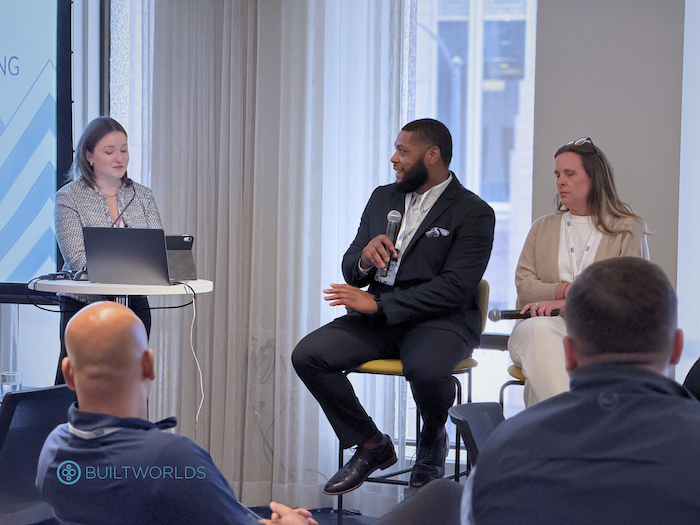
The struggles mid-sized general contractors face when it comes to tech adoption were front and center at this year’s Summit, and the conversations were enlightening. In our “Where Do I Start? Technology Development and Road Mapping for Mid Sized Contractors” panel, experts from Bulley & Andrews, HPA Design Group, PAC Leaders Construction and Fieldwire by Hilti touched on a number of tech adoption and implementation barriers common to smaller contractors. These included accountability, execution and cultural resistance. It was also noted that mid-sized GCs often assume technology will fix operational issues, but our on-stage guests pointed out that poor workflows and lack of leadership buy-in must be addressed first for tools to deliver value. There was also discussion of what “value” truly means in this context. Rather than direct cost reductions, effective technology implementation (estimating tech was an example used) can allow users to handle more work and pursue more projects.
AI Startups Are in a Race for Relevance
Following the trend of the last two years, AI infiltrated nearly every conversation had at the 2026 Chicago Global Summit. This happened, in part, because of the widespread proliferation of AI-enabled and -native technologies available in the marketplace. The challenge is knowing which of these technologies to bet on. There is now a crowded wave of AI-focused startups tackling similar problems in preconstruction and project management software. As their feature sets converge, differentiation increasingly comes from leadership, domain expertise, quality of execution, and the choice of strategic partners and investors. Those are the factors that will determine who actually emerges from the pack.
Retrofitting May be a Quicker Route to Equipment Automation
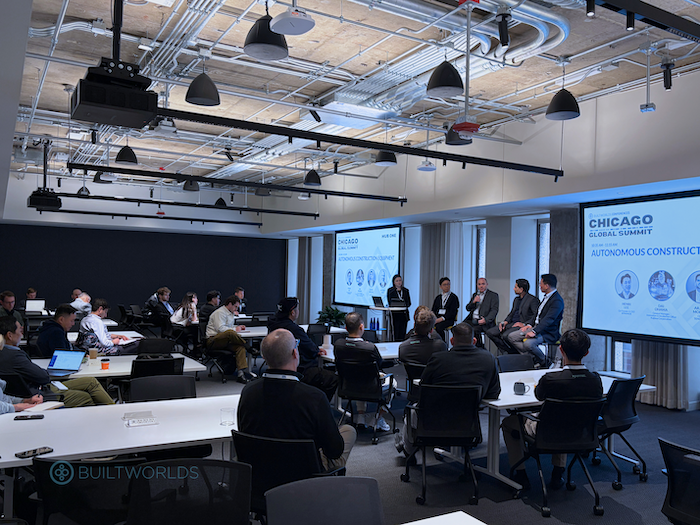
Construction has always been a litigious industry, which is not surprising considering the danger inherent in much of the work. However, as discussed by insiders from Kajima, TENDERD, Xpanner, and Caterpillar in our “Autonomous Construction Equipment” panel, that tendency, alongside customer expectations for near-perfect performance, is leading to more cautious OEMs. The large size and financial stability of OEMs, our guests explained, make them an attractive target for legal action if an incident were to occur with autonomous machinery. The group agreed that tech users may be more open to testing out/doing pilots with startups that retrofit equipment because the expectations aren’t as high. To that end, many newer companies are focusing on automating specific repetitive workflows and integrating with existing manufacturer equipment rather than trying to fully replace operators immediately.
Understanding Your Processes Is Key to Effective Tech Implementation
Another throughline at this year’s Summit, and really in a lot of tech-related conversations happening around the AEC industry, is the need for a sound understanding of internal processes before leveraging technology to solve a problem. Experts in multiple sessions emphasized the importance of understanding current pain points before implementing new systems, noting that technology alone cannot solve organizational issues. Speakers and attendees alike discussed the need for structured feedback loops between field operations and design teams, with examples shared of successful implementations including sensor-based tracking systems for critical materials. In our “Technology in the Shop: Fab Shops, Tools and Equipment” panel specifically, veteran professionals from SMACNA, Milwaukee Tool and SBK Technologies emphasized the importance of measuring the complete process from fabrication to installation, rather than just shop efficiency metrics.
If you’re interested in attending a BuiltWorlds event and taking part in the high-level networking and learning our conferences and Summits are known for, consider joining us in June for our Paris Global Summit or in July in Chicago for our Construction Tech Conference.









Discussion
Be the first to leave a comment.
You must be a member of the BuiltWorlds community to join the discussion.