
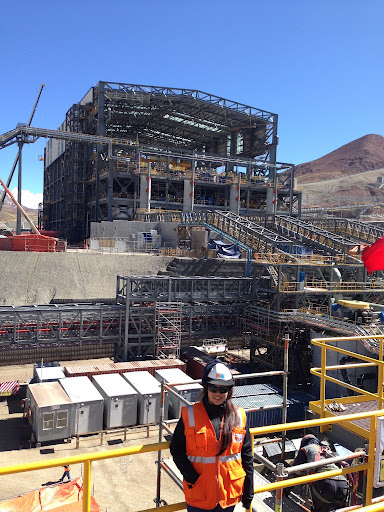
Growing up in Peru, Building Ventures Principal Mayra Arntz got her first taste of the industry watching her father operate his construction business building bridges and roads. “I not only learned about the work in the field,” Arntz recalled, “but also how the company is managed—bids, bonds, how to work with banks, insurance and payments.” After studying civil engineering, Arntz worked in Peru as a control project manager focusing on BIM modeling in commercial construction and mining projects. The experience, according to Arntz, ties back nicely to the current data center boom.
Arntz later relocated to San Francisco to complete her MBA, which was followed by influential stints at the startup HoloBuilder, a 360-degree reality capture solution, and with Stanley Black & Decker’s innovation division, where she worked closely with Stanley Ventures.
“(HoloBuilder) exposed me to the startup world and how the venture industry works,” she said. “It was a great learning experience where I realized I wanted to be in a role where I could allocate capital to entrepreneurs with great ideas to have a greater impact on the industry.”
In 2022, Arntz took her experience into a position at Building Ventures, a VC firm dedicated to reshaping the way the built environment is designed, built, and operated through both strategic early-stage investments and a commitment to mentoring founders.
“I really admire the work the (Building Ventures) team has done and how much they care for the construction industry and their founders. I thought it was the perfect fit for me because I also care deeply about the industry,” Arntz told us. “Once we are in, we’re all in. You have our time, our phone (numbers), our network. We will work together to make you the most successful company out there.”
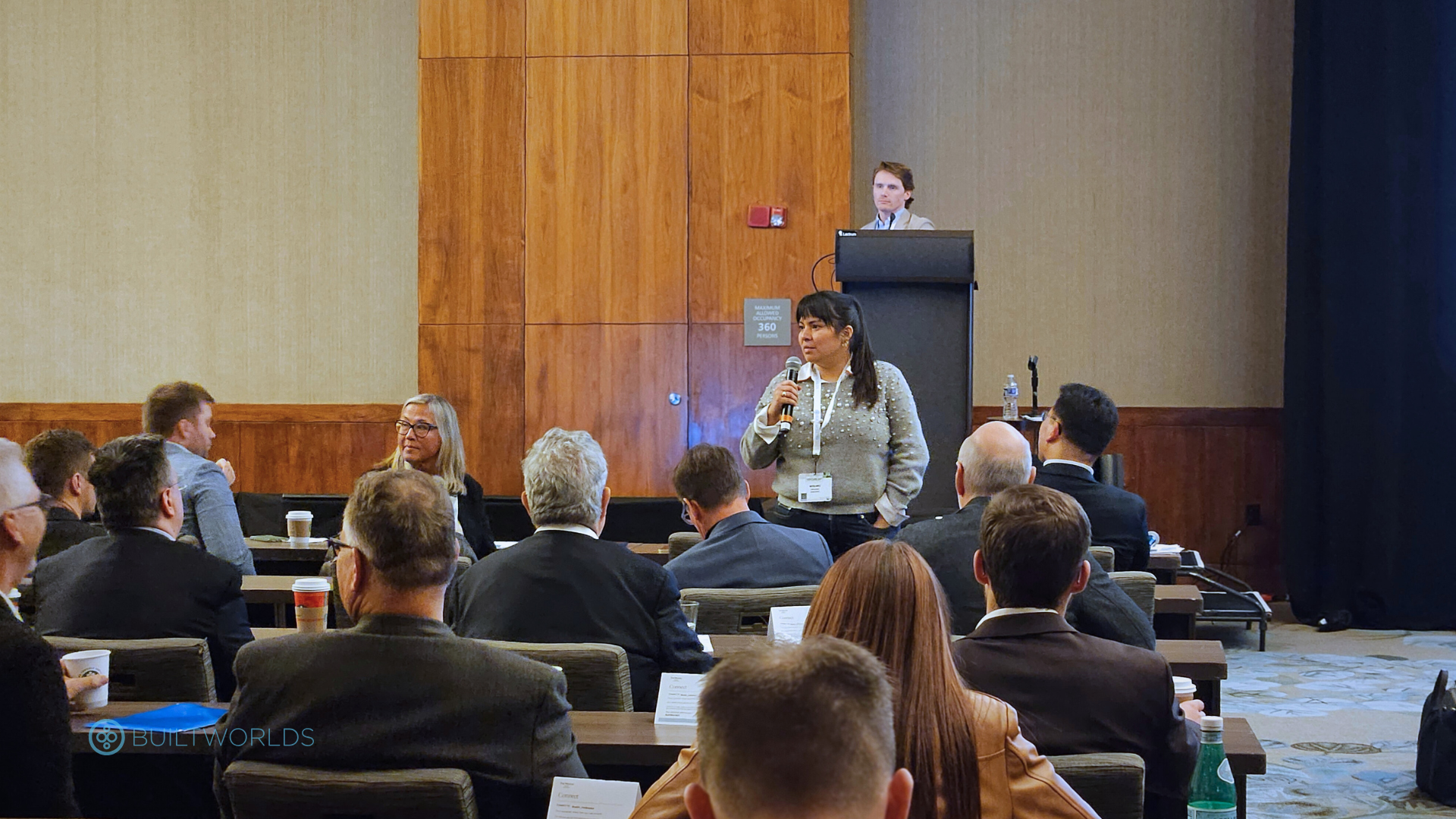
Attendees of the upcoming 2026 AI/ML Conference will have the opportunity to hear from Mayra in person. She’ll be moderating a panel on Tuesday, February 17, focusing on VC perspectives and strategies in the current moment of AEC defined by AI innovation. The panel, which was planned by BuiltWorlds in partnership with Arntz, will feature exclusively women speakers working in AEC venture. Read more to learn what this means for Arntz.
How has your experience coming from a construction family and working in construction impacted your work in the built-world venture space?
I think being exposed to the industry from such an early age, as well as studying and working in civil engineering–and all my friends in Peru work in the construction industry–gives me a good understanding of how fragmented the industry is, who the stakeholders are, and how there are so many nuances. That’s played a key role for me when I am evaluating deals. What is possible and what isn’t, what sticks and what doesn’t. I’ve gone through a couple cycles of technology adoption now, which has helped a lot with understanding what may or may not play out. A great example is VR and AR.
When I got into the industry, I remember thinking, “This is awesome. Everyone is going to be using this VR, like AR headsets.” Back then, there was so much hype around the DAQRI (AR Smart) Helmet. I really liked the technology, but when I put it on I realized that if I had to wear it in the field all day, my neck and eyes were going to hurt. And, God forbid that I drop it on the ground, because of the amount of money that it costs. Needless to say, the company went bankrupt. We’ve seen so many cycles that tried to push VR and AR into the industry without any substantial success. There’s been so much money put in this type of technology and now capital is being reallocated towards data centers and AI.
What about AI indicates to you that there’s a better chance of this hype cycle coming up with something substantial?
Well, AI is mainstream and it’s very mobile. It’s not just being adopted by one group of people, instead it’s embedded in everything and we use it in our personal life. That’s how mobile evolved, too. Once you use it in your personal life, it’s very hard to keep people from using it at work. So, companies are being forced to use it; and so for a lot of general contractors, trades, architecture and engineering firms, it’s become mainstream.
When an AEC-focused AI startup comes to market with a very large round (ex. a Series A with tens of millions of dollars), how can you tell if the market is ready to absorb that capital, especially given the long sales cycles and slower tech adoption in construction?
We are very disciplined at Building Ventures about the type of deals that we do and the type of founder that we invest in. We tend not to get into hot deals, and we don’t get in extremely early. By the time we invest, the company already has some level of revenue and a good pipeline where we can project revenue for the next 12-18 months.
We only do four to five investments a year and, with so many solutions out there, we can be a little bit picky about the entrepreneur that we’re going to back. Regarding whether the capital can get absorbed, that’s up for each investor. But based on our experience, we can make an assessment if something is really going to work, and that’s when we decide to move forward.
We’re seeing lots of advice for founders to pitch themselves as AI-based companies to access higher valuations. What, in the built world specifically, earns an AI premium?
Again, AI is mainstream. Unless you know what problem you’re solving, it’s hard for us to invest. We value what we call internally the “earned secret.” We use an image of a surfer, where the person is the entrepreneur and the surfboard is the product or technology. Then you have the wave, right? I think AI has actually leveled up, unless you are doing an LLM model, which we are not investing in. I think that one technology specific to the construction industry is what I call drone review technology, where you need a combination of LLM with computer vision to be able to understand drawings and differentiate yourself. A lot of these companies are using what is already being created by others, like Gemini. So, it comes down to what is really the problem, and where is the real pain point being solved for the industry.
With a flood of AI-powered solutions for estimating, scheduling and retrofit analytics, how do you go about underwriting valuation for point-solution AI startups in construction, and how does this differ from more established technology?
This comes back to the “earned secret.” Do they know what they are solving? Can they deliver on this? Where are they in growth and how reputable is their business? We have done investments of AI-native solutions and it’s clear that they have an advantage because their sales cycles are so quick—like, unseen in the construction industry, which means they are delivering real value to the customers.
We’re also seeing changes in the digital twins solutions. Multiple solutions are consolidating to create something new, which is definitely interesting. It goes back again to how well do the founders know this market. Estimating, for example, is such a crowded space. What is the right to win? What is different about their solution? It’s not only about the technology they’re using, but also about whether this founder can raise multiple rounds at the next level. If they are going to get to 10, can they get to 20 in the same amount of time?
In 2025, BuiltWorlds’ analysts tracked roughly twice as many Series A deals as Series B, indicating a big drop off of early-stage companies that never make it to the growth stage, also known as a “Series B air gap.” When thinking about this “gap,” where do AI‑driven built‑world startups most often stall out?
For the technologies leveraging AI, I think it’s too early to tell. The growth of the companies is what enables them to be able to raise the next rounds. If I go from 500 to 3 million in my first year, that’s a great number. It’s going to have a lot of term sheets being placed. If I cannot get that to double, or more than double, that’s going to be a problem for the founder to raise again. Then the question is, “Why did growth decelerate?” Then, in the next round if an investor doesn’t follow on their previous investment, the question becomes, “Why are they not investing anymore if this is a successful company?”
I think there are multiple factors in play that founders need to be aware of. They need to ask themselves: “How is the valuation that I’m taking today going to impact my next round if I don’t hit the milestones?” I think a lot of people are thinking about all the positive scenarios, which is great, but a little bit in the back of the mind should be, “What happens if I don’t get there?’
What we’ve seen from 2020-2021 are massive rounds that have got a lot of founders in this middle space, where they haven’t adopted AI but they’ve raised a lot of capital. The growth is not there, so they need to raise more money. But, at the bottom of the curve, there are all these new founders with ideas that are more attractive to investors because new things have so much potential.
You’ll be leading a panel at the upcoming BuiltWorlds AI/ML Conference made up entirely of women in built-world venture. How is that significant in a primarily male-dominated field?
The idea for the panel came to me at the 2025 BuiltWorlds Venture East Conference. I saw that a lot of the panels, especially the ones for VC, were all-male panels. I know a bunch of cool, female investors and thought we should have a panel where they share what they know and also show younger people and older women interested in VC that there are seats for them at the table.
I’m a Latin immigrant from a different country. I have had very different roles in my career. I’m also a mom. And, if I can do it, why wouldn’t all other women be able to do it?
I also think it’s important to see people from different locations. Like Mary (Kenney, one of the speakers on the panel) is in Ohio. Venture is not only in New York and San Francisco. There are so many other areas where you can help move the industry forward.


Discussion
Be the first to leave a comment.
You must be a member of the BuiltWorlds community to join the discussion.