
Preconstruction technology has become a staple of the buildings and infrastructure industries over the past decade, but none more so than estimating software, according to BuiltWorlds’ latest Annual Preconstruction Benchmarking Report.
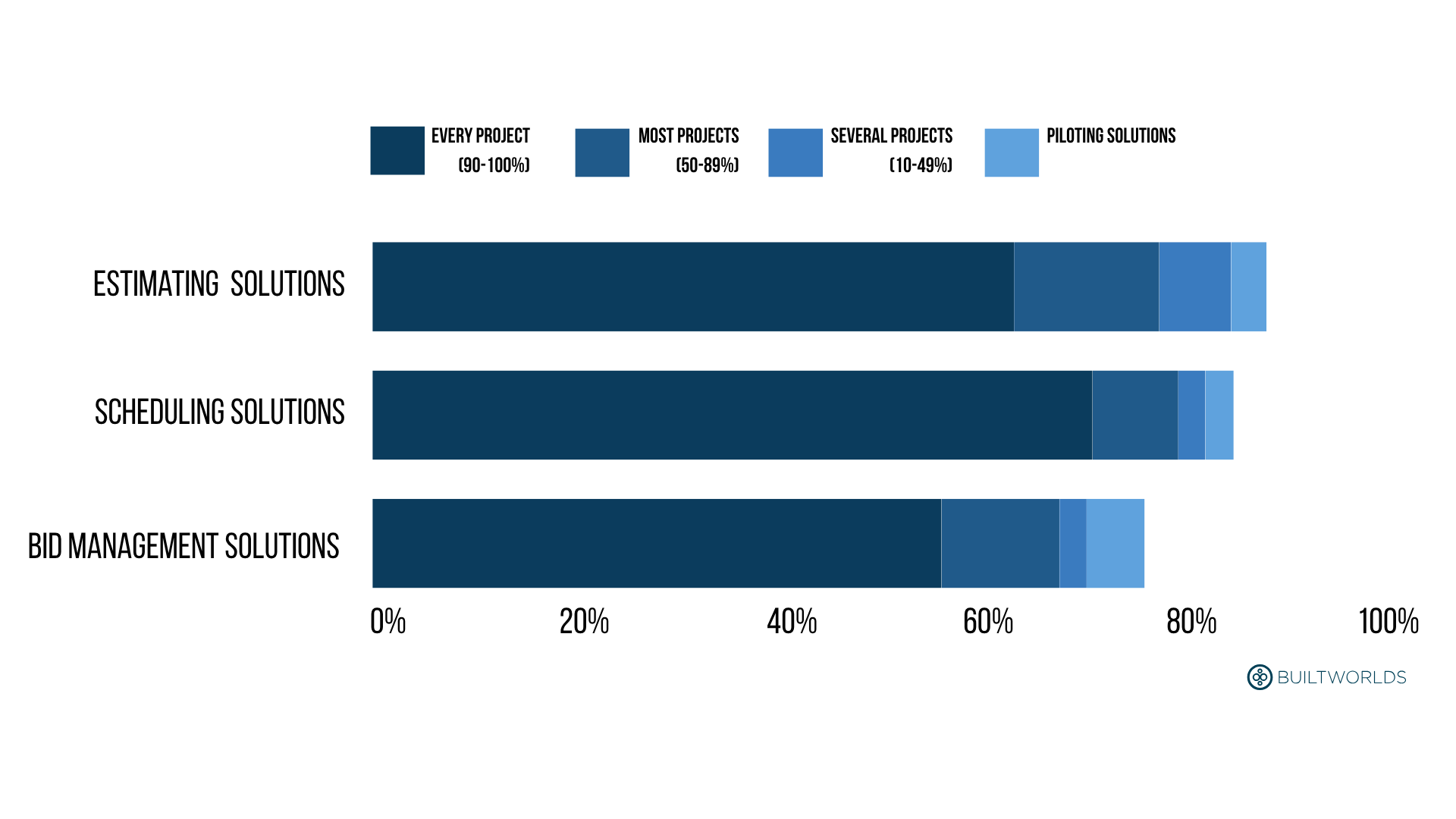
Nearly 90% of survey respondents (primarily general contractors) admitted to implementing an estimating solution at some level, with 64% saying that they use the technology on every project. That’s a 42% year-over-year increase of usage on every project, and a 392% increase from 2022—the year BuiltWorlds began collecting granular, preconstruction tech user data—when overall implementation was at 13%.
“As tech literacy and overall implementation rises throughout our industry, I’m not entirely surprised to see that estimating solutions have become a popular option,” says BuiltWorlds Research Director Audrey Lynch, noting the 22% year-over-year increase in regular usage (ie, respondents reporting usage on “several,” “most,” or “every” project). “These technologies are becoming critical to budgets and profitability but also standardization and accuracy. Ninety percent of respondents agreed that the top use case for estimating solutions was ‘achieving consistent estimating practices across the organization.’”
Among the solutions mentioned by respondents, Drawer AI received the highest user ratings while On-Screen Takeoff from ConstructConnect.
Other Popular Preconstruction Technologies
While estimating tools stood out as the most widely implemented technology in the preconstruction space, it wasn’t the only solution area to see widespread adoption.
Of the six preconstruction technology categories, three saw regular usage by over 70% of respondents: one was estimating, the other two were scheduling (83.3%) and bid management (71.5%).
“For both scheduling and bid management, more than half of the contractors using those solutions were doing so on every project,” Lynch points out. “If you look year over year, both solutions saw big increases in consistent usage. It suggests a rising level of standardization among those using the technologies.”
Digging into the implementation of scheduling solutions, the report found the majority of users (85%) agreed that “creating visual timelines of projects” and “tracking project completion” were the technologies top use cases. Regarding bid management technologies, the top use case (81%) was “improving bid comparisons and leveling.”
Discussion
Be the first to leave a comment.
You must be a member of the BuiltWorlds community to join the discussion.