

The construction industry stands on the brink of significant transformation in the coming years, driven by rapid advancements in artificial intelligence (AI). This article draws on forecasts from the AI 2027 report, published by the non-profit organization AI Futures Project, and adopts its technology roadmap as a working premise. The project is led by former OpenAI Governance Researcher Daniel Kokotajlo, who notably and accurately predicted several LLM milestones in a previous research report. This new report is built on quantitative modeling from experts and explores detailed scenarios for what could happen if AI systems surpass human-level intelligence by 2027.
How May AI Affect the AEC Industry?
This paper is a thought experiment on how the AEC industry could be impacted in the next three years given the aggressive “race” scenario predicted in the AI 2027 report. Several takeaways can be imagined based on this rapid adoption of AI into our industry:
- Companies will develop use cases based on their own workflows and begin use of AI at an enterprise level to automate management processes.
- Forward thinking companies will develop a data strategy and in-house AI capability to leverage high quality proprietary data.
-

Inferred from AI 2027 report 2025 has been marked by the proliferation of AI agents across the industry, with many lacking in reliability but improving continuously.
- 2026 is where we begin to see increasing autonomy with agents being trained with good datasets. This allows for reasoning and predictions into AI workflows.
- 2027 is predicted to see AI take a jump into decision-making and supporting field automation. This is the moment where robotics finally become more effective in the construction industry.
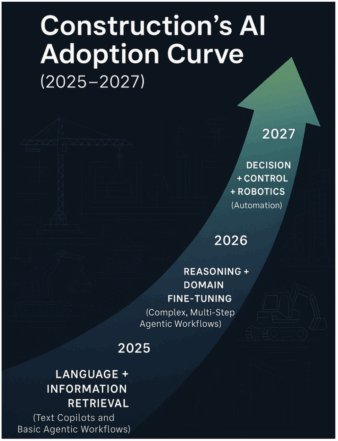
Drawing from the report’s roadmap, we envision this progression: 2025 brings early co-pilots for structured tasks; 2026 unlocks specialized models through rapid iteration and tuning; and by 2027, general-purpose AI systems are actively delivering designs, making strategic decisions, and managing robotic execution on jobsites.
While the full report explores a wide range of geopolitical, security, and societal implications, our focus is specifically on the predicted advancements in AI capabilities. We expect these advancements will lead to a multitude of changes in industry practices.
This paper aims to summarize the likely impacts of AI on construction over the next three years, with specific forecasts for 2025, 2026, and 2027.
2025: The Early Integration of AI Agents
This year marks the emergence of agents that can take multi-step actions but are often unreliable in execution. This offers glimpses of automation, though reliability often falls short. The models predicted for 2025 are bounded by systems that operate in language and code environments and require hard-coded rules that prevent hallucinations, errors, or faulty reasoning. While some models can process images, they do not yet interpret visual or spatial information reliably on their own. Their usefulness in visual tasks depends heavily on external scaffolding, including translation of images into structured text, vision model pipelines, rule-based logic to constrain outputs, and human oversight to catch failures. As a result, the agents of 2025 are limited and function more as co-pilots than fully autonomous systems.

The construction industry will begin to see the early integration of these AI agents “stumbling” into its processes and workflows. We expect agents will struggle to reliably execute processes end-to-end, showing the most utility as co-pilots for structured, text-based tasks such as proposal reviews or contract generation. These applications rely on structured documents or templated workflows where LLMs can summarize, retrieve, and generate information within constrained domains. Given that there is work to be done to provide models with sufficient, clean training data and that fine-tuning tooling is still nascent, we believe that complex workflows requiring multi-step reasoning will begin to emerge but remain largely undependable.
Key impacts include:
 Enhanced Project Management: AI tools will assist with retrieving, reviewing, and summarizing project documents across workflows like submittals, RFIs, and closeout packages, including as-built drawings, O&M manuals, and warranty logs. While agents can’t yet reason through complex planning or scheduling tasks, they can surface missing documents, suggest edits, or organize handover materials for human validation.
 Estimating and Cost Forecasting: Several agents now automate material takeoffs using computer vision to recognize and quantify building elements. While these tools can accelerate early-stage estimates, they remain too unreliable for accurate cost forecasting without significant human review.
 Improved Design Accuracy: A growing set of AI tools supports design workflows by identifying constructibility issues and accelerating drawing generation. While current systems can flag clashes or incomplete scopes with sufficient tuning, they remain far from generating high fidelity full designs autonomously. Nonetheless, these tools offer meaningful efficiency gains compared to traditional manual processes.
 Automated Contract and Proposal Responses: This is one of the most reliable applications of AI in 2025. Tools can draft proposals and review contracts by drawing on RFPs, owner data, and past submissions, often using human-in-the-loop workflows to ensure accuracy.
2026: Increased Data Integration and Automation
AI capabilities in 2026 expand meaningfully, not due to breakthroughs in autonomy, but because of accelerated development cycles, broader access to model weights, and improved data infrastructure. Algorithmic innovation boosts development velocity by ~50%, while better tooling and increasing availability of clean, structured enterprise data allows more companies to experiment. Most importantly, developers can now fine-tune models using smaller, high-quality datasets—reducing the historic reliance on massive labeled corpora of data and enabling the creation of domain-specific AI applications. As a result, more reliable, specialized co-pilots emerge across industries. Though still limited in complex, long-horizon reasoning, these agents are increasingly embedded into real workflows and optimized for practical use cases. The year is defined not by general intelligence, but by increasingly useful specialization.

In 2026, construction AI systems move beyond early-stage co-pilots to become more embedded in decision-making workflows. Rather than simply finding info in project documents, surfacing errors or missing inputs, agents can now evaluate options across variables—proposing schedule adjustments, flagging design risks based on downstream impacts, or recommending supply chain changes. This represents a step-change from 2025, when outputs were typically static or isolated. As domain-specific tuning improves, agents begin to exhibit layered reasoning and context awareness, supporting teams in tasks that previously required experienced human judgment.
The industry will experience:
 Automated Design and Modeling: Many of the design automation tools that emerged in 2025 become significantly more useful in 2026 due to improved model accuracy and increased ability to complete partial designs. While these systems still fall short of producing fully construction-ready outputs, they can now extend schematic-level inputs toward 80-90% completeness, including preliminary BIM modeling and layout optimization. This enables faster iteration and reduces manual drafting time, though human oversight remains essential.
 Smart Planning: AI will assist in planning processes such as scheduling, supply chain coordination, and site analysis by flagging tradeoffs across sequencing and planning options. While agents still aren’t trusted to finalize plans, they can check for common sequencing errors such as flagging drywall and suspended ceiling installation before overhead MEP rough-in. This represents a step beyond 2025’s static scheduling tools toward dynamic planning support.
 Risk Management: AI systems trained on real-world construction data will begin to predict project risks by analyzing patterns in design choices, team composition, and execution history. While still emerging, these models offer early signals to flag issues before they escalate.
 Enhanced Safety Measures: AI-powered safety systems become significantly more capable in 2026 due to the improved ability to fine-tune models on domain-specific data from video analytics, computer vision, and sensors. Models can now interpret site conditions with greater contextual awareness and narrative reasoning. Real-time systems reliably detect standard hazards such as missing PPE, fall risks, or unsafe equipment operation, and flag deviations from safety protocols. With cheaper inference and tighter integration, these systems evolve from isolated point detection of safety violations or hazards to site-wide, proactive safety platforms.
2027: Full-scale AI Integration With Field Automation
The report presents a pivotal decision for readers in 2027: one in which humanity either accelerates or slows AI development in response to growing capabilities and strategic risks. For our purposes, we chose the “race” scenario, in which governments and institutions double down on advancement rather than impose restrictions. Under this trajectory, AI systems transition from narrow co-pilots into artificial general-intelligence (AGI) systems, capable of autonomously driving research, design, and operational decision-making. Models run at up to 100x human cognitive speed and are deployed at massive scale, accelerating innovation through self-directed experimentation at a rate 1,000x faster than human teams.

These systems achieve superhuman performance in cognitive domains such as forecasting, strategy, and explanation. In turn, their ability to plan and control physical systems including robots and equipment improves dramatically, enabling more reliable multi-step execution in real-world environments. Interfaces also become deeply immersive, allowing for real-time intuitive collaboration. By year-end, AI is no longer a passive tool but a trusted and indispensable actor across both digital and physical domains.
In construction, 2027 marks the point where AI systems can take on both strategic decision-making and adaptable onsite automation. In the office, AI tools are now capable of managing complex planning, coordination, and decision workflows with superhuman foresight. In the field, AI-powered robotics progress beyond narrowly scoped, single-task machines to systems that can perform multiple construction tasks in dynamic environments. This unlocks workforce automation across both physical and digital layers of the industry, drastically reducing labor requirements while improving speed and precision.
The year 2027 will likely bring:
 AI-Driven Robotics: Fully functional humanoid robots capable of handling the full range of dynamic construction tasks remain out of reach in 2027. However, AI advancements in spatial reasoning, planning, and multi-task learning make it far more feasible for existing robotic systems to expand their utility. High-performing task-specific robots—like layout platforms from Dusty Robotics—may begin to handle adjacent tasks such as hanger installation, provided their hardware is adapted accordingly. With broader capabilities and higher utilization, these systems are more likely to justify their cost and reduce reliance on human operators for repetitive fieldwork. This will be increasingly important with labor shortages in construction that now exceed 500,000 craft in the US.
This transition is not optional. For designers, contractors, and the broader construction workforce, the imperative is clear: start engaging with these tools now or risk being left behind.
Predictive and Proactive Maintenance: AI will enable predictive maintenance of infrastructure by synthesizing sensor, image, and historical data to proactively detect issues in buildings and infrastructure. This allows for early interventions before failures occur, improving safety, reducing repair costs, and extending the lifespan of buildings.
Examples of these do not yet exist.
Data-Driven Decision Making: AI systems transition from surfacing options to proactively recommending specific courses of action based on comprehensive, multi-factor analysis. In higher-stakes domains like project selection, they synthesize inputs such as historical performance, risk exposure, and resource constraints to propose a clear best-fit decision, while still routing to a human for final approval. In more structured, lower-risk areas like material selection, AI agents can execute buying decisions autonomously, optimizing for cost, performance, and availability with minimal oversight.
Examples of these do not yet exist.
Three Years of AI Transformation in Construction
Over the next three years, AI would begin to transform nearly every facet of the construction industry, based on this “race” scenario. From agentic project management tools and design copilots in 2025 to automated planning and proactive safety systems in 2026, and ultimately to integrated robotics and AI-driven decision-making in 2027, the pace of change will be both rapid and unavoidable.
AEC recommendations to consider:
- Develop a data strategy and understanding of what is good vs bad data to correlate with outcomes to train models better
- Get all departments to develop a roadmap with their own use cases and problems to solve with AI
- Build AI capability in house, particularly as you implement at the Enterprise level
- Partner with others in the industry (You cannot do this on your own.)
- Set aside funds for investments and be open to experiments that may fail
- Invest in VC funds and startups in the AEC space (They need our domain knowledge and data.)
- Train your people (You owe it to them to make them modern tech-savvy builders.)
As stated in the outset, this paper assumed a more aggressive scenario, but the timeline will likely evolve. However, this transition is not optional. For designers, contractors, and the broader construction workforce, the imperative is clear: start engaging with these tools now or risk being left behind. Waiting to see how AI reshapes the industry is no longer a viable strategy. Those who fail to adopt early may find their roles and relevance fundamentally altered. For startup founders and innovators, the moment is equally urgent. Now is the time to build the foundational AI systems that will power the next era of construction, where value will shift to those who can orchestrate both machines and people in entirely new ways.







Discussion
Be the first to leave a comment.
You must be a member of the BuiltWorlds community to join the discussion.