
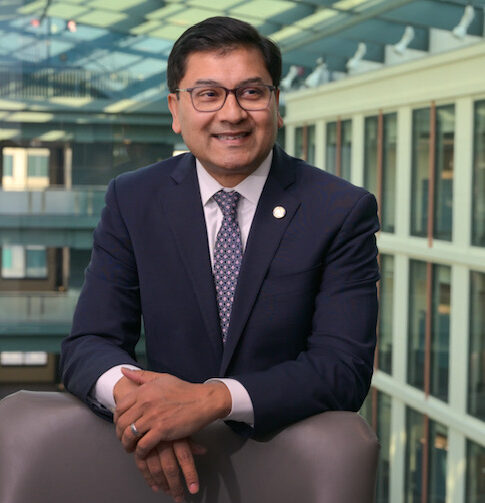
In January of this year, Amit Bose, after nearly 20 years in the transportation sector, including four years serving as Administrator of the Federal Railroad Administration (FRA), stepped down to take a much deserved break. He’s spent the last nine months resting and catching up with family. Appointed Administrator under President Joseph Biden, Bose also served as Deputy Administrator and Chief Counsel for the FRA as well as General Counsel for the Department of Transportation during the Obama administration.
Bose—a former private practice lawyer who holds a bachelor’s degree in political science and master’s degree in economic and political development from Columbia University as well as a JD from the University of Georgia—has had an impressive career since entering the transportation sector in 2007. He served as director of the New Jersey Department of Transportation and as a senior policy advisor to former New Jersey Senator Bob Menendez. He’s also held several roles in both the U.S. Department of Transportation as well as the FRA, working under both the Obama and Biden administrations. During the first Trump administration and before his appointment to the FRA under Biden, Bose held leadership roles at infrastructure solutions firm HNTB.
At BuiltWorlds’ upcoming Infrastructure Conference in Arlington, Va., Bose will share insights on navigating policy, collaborating, and funding to achieve high-impact infrastructure on a panel titled “Integrating Capital, Innovation and Strategy for Resilient Infrastructure.” In the leadup to the event, we sat down with the former FRA Administrator to discuss his impressive career and the importance of infrastructure improvements.
Tell us a little about your most-recent role and projects undertaken at the FRA.
I was fortunate to be Administrator at the FRA during a historic time for investment in rail across the country. The Infrastructure Bill gave $66 billion of investments in rail, and I ran the agency in charge of administering and distributing the funds. Some of that funding went to Brightline West, the Hudson River Tunnel, and the California High-Speed Rail project. We gave seed funding to other projects across the country, including expanding lines in the Gulf Coast and around Chicago, as well as the new Frederick Douglass Tunnel. We also gave money for corridor development, creating a pipeline of projects that may be in the early stages of development, so that these projects can continue and get to construction in the near future.
You worked at the FRA under both the Obama and Biden administrations with a gap during President Trump’s first term. In your experience, are FRA’s efforts for improved infrastructure impacted significantly with administrative changes?
Changes are inevitable when a new administration comes in. During the first Trump administration, they tried to recall roughly $1 billion in funding from the California High-Speed Rail project. When President Biden came in, his administration worked with California to reinstate that billion dollars of funding. Now, the second Trump administration is doing the same thing (as before), only this time they’re trying to recall $4 billion.
President Trump issued a series of executive orders when he came into office last January, including some calling on the Department of Transportation and FRA to relook at awarded funding. That process is, in some cases, still ongoing. Some funding has moved forward, while other funding has been taken back from projects like the high-speed rail corridor between Dallas and Houston.
Ultimately, I’d like to make infrastructure a non-political issue. Infrastructure should be viewed as beneficial for the country overall—as an investment that will pay dividends in the long term. We’re all beneficiaries of the infrastructure investments past generations have made. We need to make new investments in this generation, and it’s not just about the next couple of decades, but really about the next hundred years and beyond.
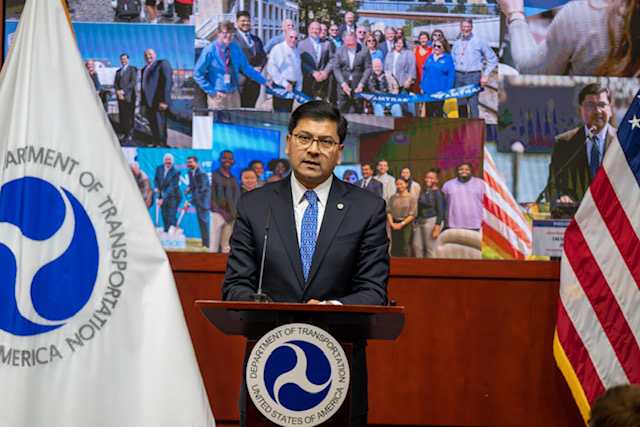
In February 2024, you wrote a letter to Jim Vena, CEO of the Union Pacific Railroad, questioning the company’s commitment to safety following the furlough of maintenance of equipment workers. Do you think that workplace/jobsite safety and healthy infrastructure are intertwined?
There is definitely a connection between workplace safety and infrastructure projects, especially on the rail side. Sometimes rail projects happen on active rights-of-way on active corridors where trains are operating. When that happens, there are times given to do construction, and worker safety is paramount.
When I was with the FRA, we talked to the project sponsors, labor organizations, and railroad companies. Union Pacific is actually a part of some of the projects that are ongoing and receive grant dollars. We talked to all of those groups to make sure that they’re collaborating and all knew that the level of construction activity was going to be heavy. Worker safety is crucial to have those projects go forward, and we definitely want to make sure that the projects on the railroad tracks proceed in as safe of a manner as possible.
According to a 2022 survey of 1,280 registered voters nationwide, conducted by Change Research, only 6% of respondents rode on trains monthly while 69% of voters surveyed responded that they never ride trains. Why, then, is train infrastructure critical to America?
In places in the U.S. where railroad corridors are part of people’s daily lives, railroads are almost taken for granted. During my time at FRA, we tried to bring those opportunities to more people in more places across the country. We saw interest in places like Denver, Co., so they’re working on a corridor there. We also started Borealis Service between the Twin Cities and Chicago, which has met or exceeded ridership estimates even with slower trains. It spurred a lot of interest and a lot of ridership, which I think indicates an underlying enthusiasm for rail, which adds more travel options for people without drivers licenses or who want to read or talk rather than focusing on the road.
Beyond increasing travel options for potential riders, freight trains carry goods across the country. We had infrastructure funding for those projects as well, so long as there was a public sector partner or it was a short line railroad. In some cases, passenger and freight rails share tracks, so those improvements can actually benefit both passenger and freight.
I’m convinced that continued rail infrastructure is more important than ever because it also boils down to a matter of economic competitiveness. East Asia has very robust rail networks. Parts of Africa, like Morocco, also have pretty good networks. We want to make sure that the United States doesn’t fall behind those other parts of the world when it comes to rail infrastructure.
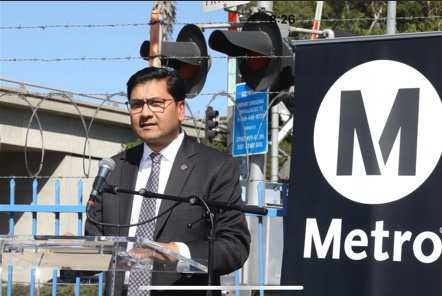
In your opinion, what should the top priority be for improved infrastructure (railroad or other) in the U.S.? How do we go about achieving this?
Obviously I’m biased towards rail, but there are significant needs across the board. Road infrastructure has some significant bridge projects, as well as highway capacity improvement projects. Local roads need more assistance and get overlooked, especially last-mile roads between ports and cities because those roads are so heavily-traveled by trucks and are prone to more damage and require constant retooling.
But, the U.S. has a lot of catching up to do on rail because there was significant underinvestment. They tried in the 2009 Recovery Act, but the funding dried up between 2015 to 2021. There was a huge infusion in 2021, with that $66 billion, but it’s a concern whether that level of funding will continue. When other modes of transportation get funding, it’s usually sustained or even grows over time. We need to do that for rail, and we also need to make sure that these projects are delivered on time and on budget to show there’s responsibility and accountability.
I’m also convinced that when people ride new services like Brightline Florida and, hopefully Brightline West and California’s High-Speed Rail in the future, there is an excitement that spreads. When people see something in one part of the country, they want it where they are. It’s important to get these projects in service to build that momentum across the country.

What have you been up to since leaving the Federal Railroad Administration in January and what is next?
I’m still deciding whether the private sector or public sector is next for me, but I’m looking forward to what’s ahead. I’m excited to be speaking at BuiltWorlds’ Infrastructure Conference, because it allows me to be engaged with the industry and also to hear what’s been going on in the past nine months. I was lucky enough to be on the first Gulf Coast train between New Orleans and Mobile in mid-August, and I was on the new Acela train between New York and Boston. It just continues to amaze me to see the things that we did over the past four years come to fruition and really benefit the country.

Discussion
Be the first to leave a comment.
You must be a member of the BuiltWorlds community to join the discussion.