
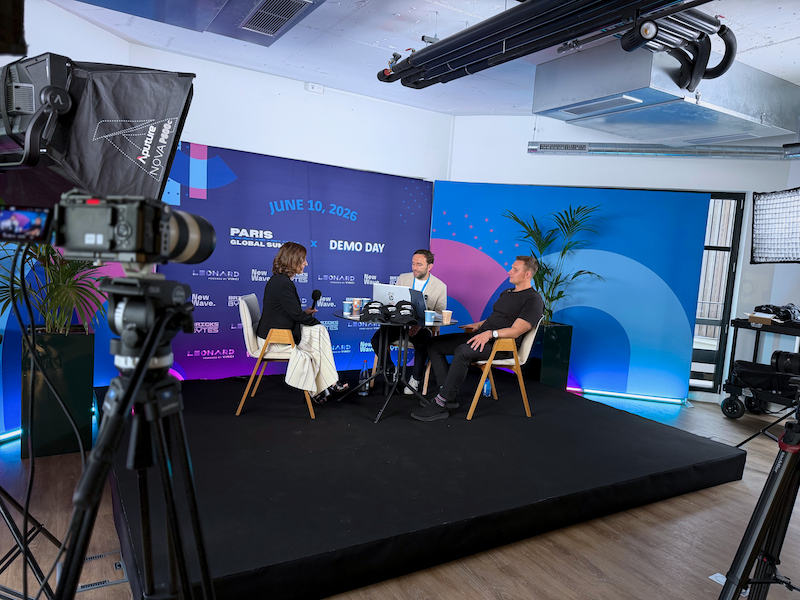
This year’s Paris Global Summit was special. It was intimate, actionable, and its holistic content examined the full, sweeping landscape of built environment tech, considering the perspectives of contractors, investors, and technology solution providers alike.
It was an event for AEC industry leaders and decision makers. Ninety percent of this year’s attendees were director level or above, while a quarter were C-suite. The event saw CEOs, innovation and technology chiefs, startup founders, and VPs, heads and directors of a variety of technical departments from companies all throughout the globe come together for a rare exchange of information and insights.
Over three days, our small group of majority BuiltWorlds members explored Paris from an AEC lens. We visited VINCI’s “Charge as you Drive” project—an induction-based charging system for vehicles built directly into roadways that has massive potential to transform EV infrastructures around the world—and were guests at Dassault Systèmes’ 3DS Velizy Campus, where we heard from company leaders and technical experts on AI strategy and were given a behind-the-scenes look at the company’s impressive FabLab. We spent a day at Vinci’s innovation facility, Leonard, learning about France’s rapidly evolving startup ecosystem and hearing from more than a dozen founders on the ins and outs of their novel technologies and business models. The Summit’s final day included nearly eight hours of diverse programming at the beautiful Les Salons Hoche followed by the highly anticipated 6th Annual Global Innovator Awards ceremony atop Saint-Gobain’s headquarters in La Defénse, which boasts one of the best views in all of Paris. .
While the connections made and experiences had at the 2026 Paris Global Summit can’t be duplicated online, we are able to share a few of the lessons learned for those who were unable to make the event. Of course, there are too many to share in a single article, so we’ve chosen a few that give at least a glimpse into the discussions and presentations that helped define the event.
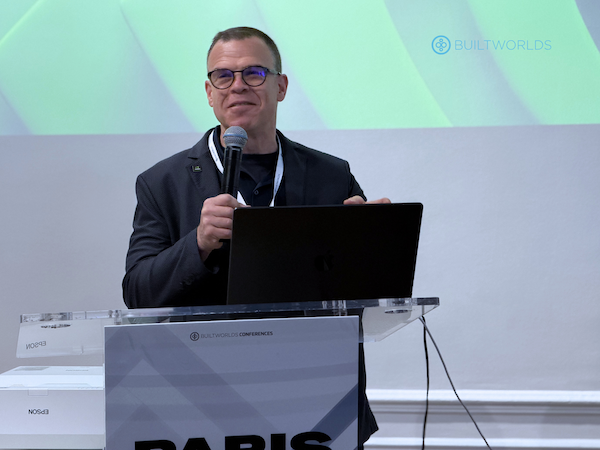
Digitizing the Worksite Opens Up Artificial Intelligence Use Cases
The AI explosion has happened. It’s left some with hope for the future of the industry and plenty of others with confusion as to how to implement it effectively. As much potential as AI has, reaching that potential is proving a considerable challenge for many throughout the global built environment.
NVIDIA Head of AEC Sean Young, keynote speaker of this year’s Paris Global Summit, believes that part of reaching that potential lies in digitizing the jobsite. “Digital twins are really important for all of this, and not because it’s a cool visualization,” he said. “It’s because for AI to understand what’s happening in the world, it needs data.”
Data is already a challenge for contractors implementing AI, according to BuiltWorlds’ latest Annual AI/ML Prepared Research Report. More than half of respondents agreed that the “limited availability or quality of data” is one of the “biggest hurdles” to effective AI adoption. Using a digital twin and the data it continually produces, Young said, can be used to train AI for a wide variety of applications, like informing robotics of what tasks need to be done or letting on-site cameras know what to look for in terms of progress. There are countless tasks that AI may be able to do, but as Young explained, “it needs to be trained properly.”
Digital twins are really important for all of this, and not because it’s a cool visualization. It’s because for AI to understand what’s happening in the world, it needs data. -Sean Young, Head of AEC, NVIDIA
Construction Robotics Are Here
Much like AI, construction robotics are no longer theoretical. We’ve, of course, known that for some time, as BuiltWorlds’ Annual Equipment & Robotics Research Report last year found that nearly half of contractors were using automation and robotics on jobsites to some degree; but the “early adoption” window is quickly closing.
It was a point made throughout the Summit; though, it was perhaps most poignantly made during the case study in jobsite automation presented by representatives from Gravis Robotics, Zacua Ventures, Vinci UK and Imad Ventures. “For me and the business, it’s not really about individual point solutions,” said Philip Reid, head of innovation and transformation for Vinci Construction’s UK Division. “It’s this recognition that automation is coming. We need automation for all of the reasons that we need it.”
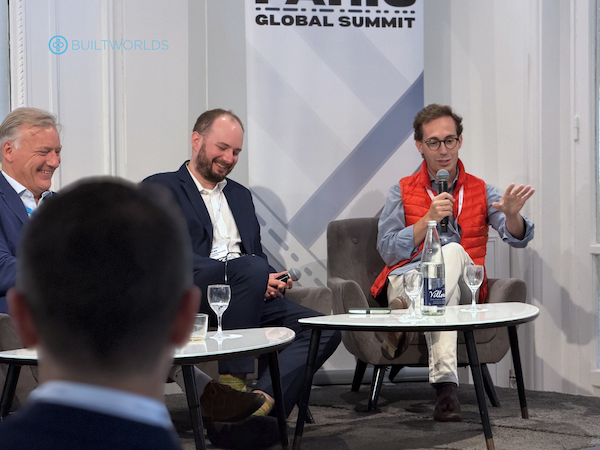
Explaining Vinci UK’s use of Gravis Robotics, a company that retrofits jobsite equipment to achieve autonomy, he talked about the safety benefits first and foremost—the obvious ones as well as the not so obvious. “We thought it was all about taking the operator out of the cab,” he said.” But the biggest benefit wasn’t reducing the operators. It was removing the engineer that stood next to the machine that was having to go out and measure things.” Reid explained that because of LiDAR’s precision and the accompanying automation, there was no longer a need for the engineer to be near the machine and “in harm’s way.”
During their discussion, Imad Ventures (the CVC arm of Nesma & Partners) Investment Principle Juan Carlos Sanchez speculated that robotics are likely to be commonplace on jobsites within three to five years. He cited safety requirements and construction’s longstanding labor and productivity woes as only some of the drivers. Coupled against the rise of hyperscalers, increased demand to build super rapidly, “increasingly cheaper” hardware, and the release of sophisticated spatial AI technologies, robotics are quickly becoming a realistic option for contractors of all sizes and revenues.
We thought it was all about taking the operator out of the cab. But the biggest benefit wasn’t reducing the operators. It was removing the engineer that stood next to the machine that was having to go out and measure things. -Philip Reid, Head of Innovation and Transformation (UK Division), Vinci Construction
The Scaling Conundrum
The AEC industry is famously risk averse—which makes sense, considering the job is dangerous and the margins are thin. Alone, the thought is nothing knew, but the problem was a popular point of conversation at this year’s Paris Global Summit by way of the industry’s increasingly unavoidable scaling challenges.
“We do not have a technology issue (in construction),” said BuiltWorlds CEO Rosemarie Lipman during an interview on the popular industry podcast Bricks and Bytes, which put on a live show during the event. “We have an adoption, implementation and scale issue.”
With a proliferation of new tech in the AEC space—BuiltWorlds has tracked more than $85 billion across 2,800+ built environment tech deals since 2021—contractors are exploring options for efficiencies and opportunities for optimization. However, contractors at this year’s Paris Global Summit also talked of experiencing poor or failed pilots, leaving them even more averse to the risk of investing in newer technologies. But it’s not the only barrier to adoption.
Data security, unresolved liability regarding physical AI and site monitoring, contractors moving away from point solutions—all were mentioned as barriers to adoption throughout both the European and global AEC markets. The solution, so far as many of our attendees see it, will require a combination of increasing widespread technology readiness levels, contractors building trust with new types of technology (especially AI and robotics), and both tech companies and contractors proving and further validating the ROI of these tools.
BuiltWorlds events prioritize actionability and experience, making sure our attendees leave with ideas to implement and meaningful, valuable connections to build off. If you’re interested in membership, please let us know here and we will reach out with additional information. We also encourage AEC stakeholders interested in the increasingly complex landscape of built environment tech to join us at the 2026 Construction Tech Conference.










Discussion
Be the first to leave a comment.
You must be a member of the BuiltWorlds community to join the discussion.