
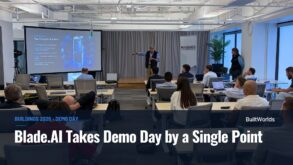
blade ai by Inertia Systems won the Demo Day pitch competition at the Buildings Conference: Data Centers & AI Infrastructure in Nashville. It was the closest finish of the year, with just one point separating first and second place.
David Wilkinson, Sales Director at Inertia Systems, pitched alongside CTO Mark Klusza. Their platform uses AI to turn 2D drawings and 3D models into live, object-oriented datasets: building models that know their own properties and relationships. Inertia Systems is preparing for a Series A, has strong pre-sales from its existing customer base, and launches its MVP in October.
Six AEC startups competed for the win before a panel of expert judges: Abhishek Bansal (Zacua Ventures), Aki Manda (Kajima), Valentin Piperno (Leonard) and Daniel Tarlas (Gray Capital Investors). Here’s what stood out:
1. Data fragmentation is the problem everyone is chasing.
blade ai wasn’t alone. Two other startups also went after building information scattered across drawings, models and documents.
- Anyset AI organizes project data at handover into usable building records for owners. Co-Founder & CEO Sergey Grushko said the company is targeting the ENR top 50 contractors and aims for $500K ARR by year-end.
- Piassa builds an intelligence layer for building operations. Founder & CEO Mubarek Hassen reported early customers seeing 36% cost savings and 78% time savings.
2. AI is moving from co-pilot to autopilot.
Several founders described AI that does the work itself, not just tools that help people work faster. Two pitches showed what that looks like: weeks of expert effort compressed into hours.
- PODIUM.io, spun out of Lendlease in 2024, compresses development feasibility work into a single day. Founder & Board Member William Ruh demoed it on a Singapore data center campus. The company has 20+ customers and plans a shift to agentic “autopilot” in 2027.
- DeepMechanix is building an AI-native engineering and construction firm. CEO Aman Thakkar showed a pressure-vessel design tool that produces code-compliant designs in 1–2 hours, versus 12–50 engineering hours by traditional methods.
3. Mission-critical facilities are the beachhead.
Data centers, hospitals and universities came up repeatedly as the first market. These owners can’t tolerate downtime, so they pay for reliability.
4. Wedge in narrow, then expand.
Breadcrumb, led by CEO Simon Elliott, digitizes site safety orientation. It now counts 33 U.S. customers across 31 states and over 1.4 million worker profiles worldwide, and is building toward project management and insurance from there. The judges pressed every founder on this same path: how does a focused entry point become a platform?
Your startup could be on the next Demo Day stage.
BuiltWorlds Demo Days put founders in front of the general contractors, owners, investors and corporate venture arms who buy and fund built-world technology. Presenters get a pitch slot, live feedback from judges, and introductions that continue well after the event.
Upcoming Demo Days:
- AEC Emerging Tech, Boston, Nov 18–19, 2026
- AI/ML Conference, Austin, Feb 17–18, 2027
Applications are open to construction tech, building tech and infrastructure tech startups from pre-seed through Series B. Apply to present at a BuiltWorlds Demo Day →
Discussion
Be the first to leave a comment.
You must be a member of the BuiltWorlds community to join the discussion.