
The majority of the construction industry is embracing artificial intelligence, albeit at varying levels of implementation, but significant challenges remain that may ultimately stunt adoption rates, according to the 2025 Annual AI Benchmarking Report from BuiltWorlds.
Nearly two-thirds of respondents to the 2025 AI Benchmarking Survey—the source of data upon which this latest report was built—described their company’s AI maturity level as at least “average,” with 22% calling it “above average.” The findings, according to the report, suggest that “companies are experimenting with AI tools but have not yet achieved broad integration into core workflows.”
That assessment was further reinforced when respondents were asked, “Is AI a core strategic focus company-wide?” Thirty-five percent reported that their company had yet to fully embrace AI but were actively exploring its potential; thirty-three percent reported that it was a core strategic focus but was limited to specific departments or initiatives; and 27% reported that the technology was indeed central to the company’s overall strategy. Only 4% of respondents said, “No, AI is currently not a core strategic focus for us.”
The Driving Motivators for AI Adoption
The report identified several motivators that are driving widespread AI investment and adoption; though, there was no factor more influential than the technology’s promise of improved operations.
“At this stage in AI’s development, early adoption is admittedly something of a gamble—same as it would be for any burgeoning solution—which is why it’s not uncommon for companies to be a bit apprehensive about investing in the tech,” says Audrey Lynch, director of research for BuiltWorlds as well as the report’s author. “But of those who are adopting AI, they’re doing it for similar reasons.”
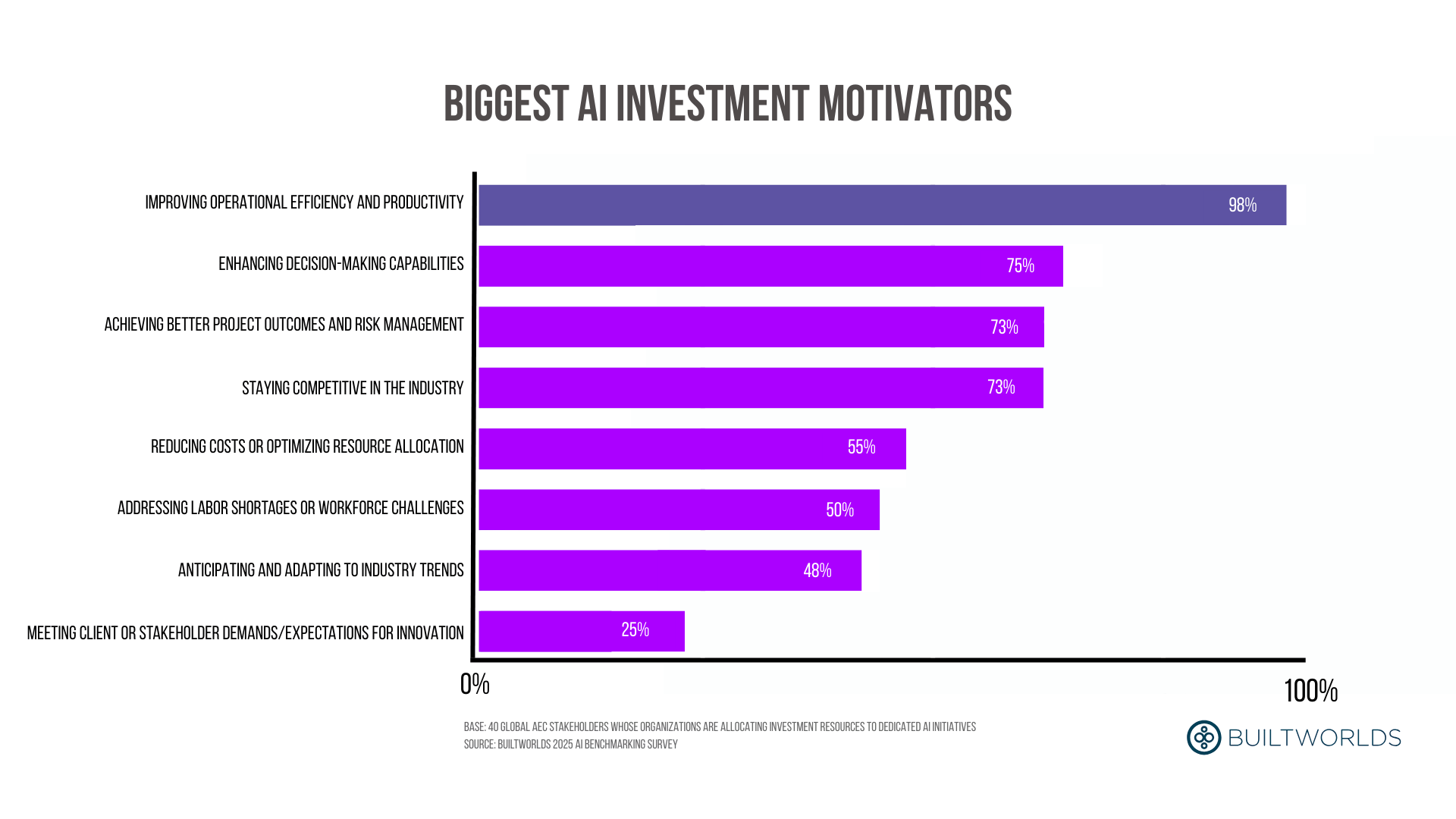
Nearly 100% of respondents agreed that “improving operational efficiency and productivity” was a primary driver behind their organization’s decision to invest in AI tools. It was the favorite answer across all responses, followed closely by “enhancing decision-making capabilities” (75%), “achieving better project outcomes and risk management” (73%), and “staying competitive in the industry” (73%).
The report reads that our “benchmarking data suggests that AEC organizations are primarily focused on AI adoption as a means to strengthen core operations rather than pursue disruptive innovation.”
The Hurdles Companies Face in Adopting AI
Still, while current AI promises to bolster certain workflows, the technology is not without its perceived challenges.
“Construction is not a traditionally tech-forward industry and is therefore not well equipped for a smooth, at-large transition into AI implementation,” Lynch says. “There are genuine concerns and weak areas that give pause to stakeholders throughout the AEC industry.”

In asking respondents what those reasons may be, data concerns, limited internal skillsets, and an admittedly shaky understanding of AI’s use cases and ROI topped the list. More than half of respondents specifically cited “concerns about data privacy and security” (62%), “lack of internal expertise or skilled personnel” (58%), and “limited availability or quality of data” (56%).
“It’s important to note that these challenges likely stem from the technology’s relative immaturity and the industry’s historical resistance to widespread innovation,” Lynch says. “They’re leading to hesitations but have done little to damper enthusiasm.”
While 2% of respondents admitted to being “skeptical” of AI, 27% are “cautiously optimistic” and the overwhelming majority (69%) described their feelings as “excited.”
Says Lynch, “There’s a real appetite for technological change in our industry.”
Discussion
Be the first to leave a comment.
You must be a member of the BuiltWorlds community to join the discussion.