
Hamid Rezaei has spent the last two decades working across Canada and the United States, as well as across both public and private sector organizations, delivering complex transportation and transit projects. With postgraduate degrees in engineering, and a focus on large-scale infrastructure planning and delivery, Rezaei’s career path has been shaped by a deep interest in infrastructure delivery models balancing technical innovation, financial efficiency, and long-term operational performance.
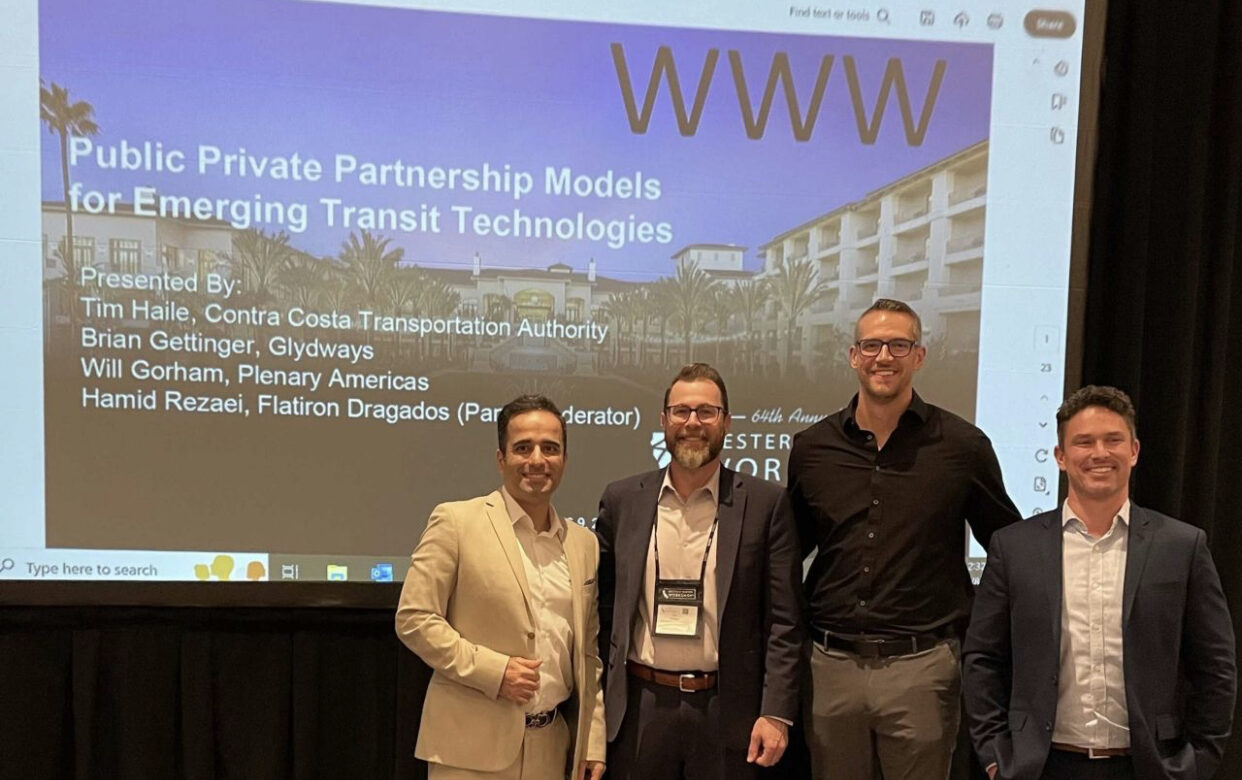 Hamid Rezaei (left) pictured with fellow presenters at the Western Winter Workshop.
While working in joint venture and global partnerships for multi-billion dollar design-build programs, Rezaei developed a specialization in early-stage project development, risk management and stakeholder collaboration—critical skills in P3 projects where “the private and public sectors must align on outcomes that serve both community needs, environmental stewardship and long-term sustainability goals.” He joined FlatironDragados in 2021 and currently serves as a director/project executive, leading the company’s emerging market division across North America, as well as the planning, preconstruction, and implementation phases of large-scale design-build programs.
We’ll be hearing from Rezaei at the upcoming BuiltWorlds Infrastructure Conference on a panel titled “Next Gen P3s: Rethinking Infrastructure Delivery for Resilience and Long-Term Value,” exploring how emerging public-private partnership models are reshaping infrastructure investment and driving more resilient, sustainable, and integrated infrastructure systems. In the leadup to the 2025 Infrastructure Conference, we had the opportunity to sit down with Rezaei to get a better understanding of his extensive background in P3 projects, as well as the importance of P3 projects in maintaining and reshaping critical infrastructure.
Tell us a little about your role and current projects at FlatironDragados.
Joining FlatironDragados gave me the platform to work on some of the most ambitious infrastructure projects in North America, particularly in the emerging transportation technology space.
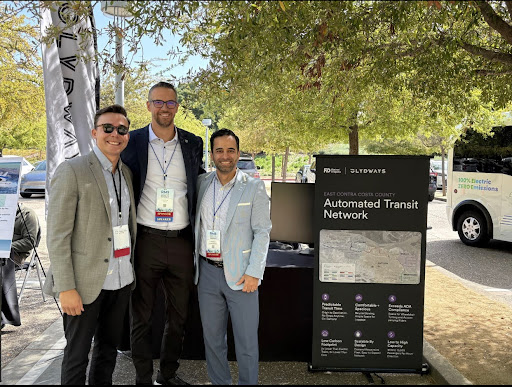
Currently, I lead the Emerging Technology group for FlatironDragados, where innovative technologies intersect with large-scale construction.
For example, I work closely with Glydways, a California-based technology innovator in Automated Transit Network technology, best known for developing the Glydcar—a carbon-neutral, zero-emission personal rapid transit system. Designed for first-mile/last-mile connectivity, the Glydcar operates on a dedicated guideway, offering a sustainable alternative to traditional transit modes.
My focus is on making such technologies constructible, scalable, and adaptable from a civil infrastructure design and delivery perspective. In doing so, I’m not only creating new business opportunities for our company but also helping to advance technologies that have a meaningful, positive impact on our climate, communities, and the way we move through our cities.
Can you describe the benefits and challenges unique to P3 projects?
P3 projects provide significant benefits in aligning public objectives with private-sector expertise and resources. One of the most notable advantages is the ability to accelerate project delivery by transferring design, construction, financing, and long-term operations risk to a partner with the capacity to manage it efficiently. This often results in innovative design solutions, lifecycle cost savings, and enhanced asset performance over decades.
However, these projects are not without their challenges. Negotiating complex agreements, ensuring long-term alignment of incentives, and balancing public accountability with private performance metrics require significant effort. The procurement process can be lengthy and resource-intensive. Stakeholder engagement is critical to avoid public misunderstanding. One example that comes to mind is the Automated Transit Network project in Contra Costa County where the P3 model allowed for integration of cutting-edge autonomous vehicle systems into a public transit framework while securing private capital to manage long-term operations. On the other hand, the complexity of integrating multiple regulatory and technical standards posed early-stage challenges that had to be addressed through joint governance structures.
Are there any common misconceptions about P3 projects?
People often think that P3s equate to privatization. In reality, P3s maintain public ownership of the asset while leveraging private expertise for delivery and management. Another misconception is that P3s are inherently more expensive; in many cases, whole-life cost analysis shows the opposite, as risk is priced and managed more effectively over the asset’s lifespan.

In your experience, what makes for a successful P3 project and can you give examples?
Success hinges on three main factors: a clearly defined scope, a well-structured risk allocation model, and sustained collaboration throughout the project’s life. My advice for public agencies is to invest in early project definition and market sounding. Agency decision-makers need to ensure that they understand the private sector’s appetite for risk and innovation, and establish governance mechanisms that allow for adaptive decision-making without compromising transparency.
On the flip side, private entities need to engage early in the procurement process to understand public objectives beyond the technical specifications. These leaders need to build flexibility into their delivery model because long-term projects must adapt to evolving policy, technology, and stakeholder needs.
What innovation in infrastructure are you most excited about and why?
I am particularly excited about the integration of automated, connected, and zero-emission mobility systems into existing transport networks. The convergence of intelligent infrastructure with sustainable energy systems has the potential to transform urban mobility, reduce emissions, and increase capacity without extensive new right-of-way. P3 models are well-positioned to advance these technologies by de-risking early deployment and ensuring performance-based outcomes.
The American Society of Civil Engineer’s 2025 Report Card for America’s Infrastructure released this year gave the country a C-rating, with grade increases in eight out of the 18 categories included in the report. In your opinion, what should be the highest priority to increase that rating for the next report card in 2029 and how can we achieve that rating?
I believe the priority should be addressing deferred maintenance through asset management strategies that focus on lifecycle performance, not just initial capital investment. This means funding rehabilitation and modernization alongside new builds; and leveraging data to prioritize interventions where they deliver the highest public benefit.
To achieve a higher rating, we must combine sustained federal and state investment with performance-based delivery models. This includes expanding the use of P3s where appropriate, integrating advanced materials, and adopting predictive maintenance powered by AI and IoT data streams.
With federal funding for infrastructure in flux since January, the Trump administration recently announced $500 million in BUILD grants. Has the political climate impacted the prevalence or importance of P3 projects on a federal level?
Yes, the political climate does influence the prevalence and importance of P3 projects, particularly at the federal level. When federal funding fluctuates, states and municipalities increasingly turn to P3 models to ensure continuity of critical infrastructure programs. For example, in February, the current administration temporarily froze $5 billion in funds for the NEVI (National Electric Vehicle Infrastructure). The DOT recently started the process to release those funds, but the freeze led several states to explore alternative financing and delivery models to keep EV charging network plans on track. In many cases, P3 structures provided a path forward, with private operators taking on deployment risk in exchange for long-term revenue-sharing arrangements.

Discussion
Be the first to leave a comment.
You must be a member of the BuiltWorlds community to join the discussion.