
In 2026, offsite construction stopped being a side bet. Instead, it became part of how large builders plan to grow. That is the clearest of the offsite construction trends we tracked this year. It showed up in BuiltWorlds Offsite Construction Research Track working groups, on conference stages from Phoenix to Paris to Tokyo, and in early results from our 2026 Offsite Benchmarking Survey.
In fact, offsite was never a one-session topic. It came up at every BuiltWorlds conference this year. Most recently, in October, Mortenson’s BLU labs brought it to the Tokyo Summit’s business strategy working group. Their focus was scaling prefab to the needs of a multi-billion dollar revenue company. In short, offsite is core strategy, and it threads through everything we program.
In the Phoenix area? We’ll dig into these findings in person on December 2 at our Phoenix Member Lunch & Open Working Group at The Capital Grille at Biltmore Fashion Square.
So here are eight things we learned, and where the conversation goes next.
Eight offsite construction trends from 2026
1. Offsite is now strategy, not a pilot
In early 2026 survey results, 22 of 23 member companies in our Offsite Research Track said expanding offsite is part of their three-year strategic vision. Also, 21 of 23 plan a prefab or modular project in the next year. Nearly all have a dedicated offsite team, and most run their own prefab facilities.
2. For BuiltWorlds member companies, The spend is going up
Meanwhile, 19 of 22 Offsite Survey respondents expect offsite’s share of their construction spend to grow over the next three years. For 14 of them, that growth will be significant. Five already put half or more of their annual spend into offsite methods.
3. Data centers are the launchpad
Respondents ranked data centers as the top end market for offsite growth more often than any other. Speakers including DPR and Mortenson’s BLUvera see that work as a template. In their view, healthcare, multifamily and other asset classes will borrow the data center playbook, from multi-trade MEP racks to power skids.
4. The winners are productizing
At the Paris Global Summit, DPR, Kier, Grupo Casais and EcoWorks agreed on how to scale. Above all, scale comes from repeatable components, vertical integration and product configurators, not one-off designs. Similarly, Mortenson’s Nate Haack framed it plainly at our September working group session: AI infrastructure is forcing a shift from projects to products.
5. It’s about speed and labor, more than it is about cost
Respondents ranked a streamlined schedule as the top benefit of offsite. Next came offsetting labor shortages. However, lower project cost ranked near the bottom. In other words, offsite is currently selling more on certainty and capacity, than it is on a cheaper bid.
6. People, not technology, are the biggest barrier
Respondents most often cited resistance or a lack of understanding from other stakeholders. That obstacle came ahead of design limitations and a thin project pipeline. On the other hand, they said design-build is the delivery model that best enables offsite.
7. The fab shop needs better software
Prefab design tools scored lowest on cost control and on integration with the rest of the tech stack. At the Chicago Global Summit, fabrication leaders agreed that interoperability, not hardware, is the bottleneck. They also warned that no tool, AI included, fixes a process that no one has mapped. So, we can expect to much more on this in 2027.
8. Industrialized construction is going heavy
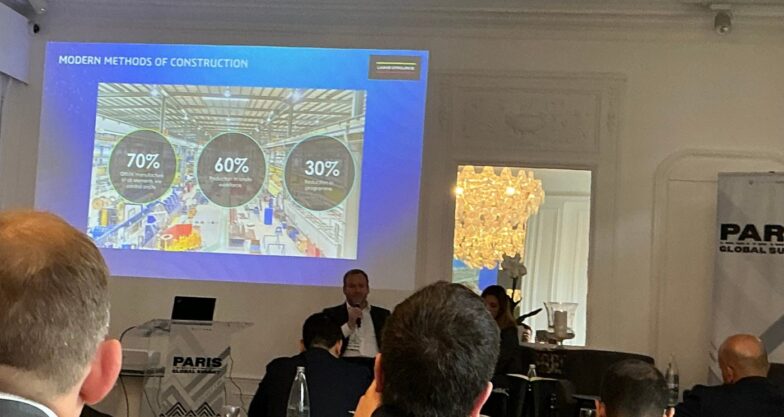
Finally, offsite is no longer just bathroom pods and wall panels. In Paris, Laing O’Rourke described moving 70% of construction offsite to cut schedules by about 30%. For example, its team made 8,000 tons of reinforcement in a factory for the Hinkley Point C nuclear plant. Together with Dassault Systèmes, it designed that work as a “civil kit of parts.”
Survey figures are interim results from the 2026 Offsite Construction Benchmarking Survey. We report them in aggregate thought individual members get individualized reports. The full benchmarking report is coming in the next week along with deeper segment reports helping break down the solutions accompanying member processes.
What’s next for offsite construction, and how to get involved
First, the conversation continues next week in Phoenix. On Wednesday, December 2, we’re hosting a Phoenix Member Lunch & Open Working Group from 11:30 a.m. to 1:30 p.m. It brings together construction, real estate and technology leaders across the Valley. Expect member updates, key insights on offsite construction trends from our latest research and an open discussion of 2027. Because it’s an invite-only gathering, please request a spot on the event page.
Next, watch for two releases in the coming week. Our 2026 Offsite Top 50 list and the 2026 Offsite Construction Benchmarking Report will share the full results. Then, in April 2027, the Offsite working group meets at the Chicago Global Summit on “The Economics of Offsite.” In addition, our research partnership with Illinois Institute of Technology’s Fabrication Center gives the track a working lab in Chicago.
- Add your data: the 2026 Offsite Construction Benchmarking Survey is still open and takes about 15 minutes.
- Join the conversation: the Offsite Construction Research Track runs closed-door working groups at every BuiltWorlds conference. Conference pass holders can sit in on one for $500, credited toward membership.
- Get in touch: research@builtworlds.com





Discussion
Be the first to leave a comment.
You must be a member of the BuiltWorlds community to join the discussion.