

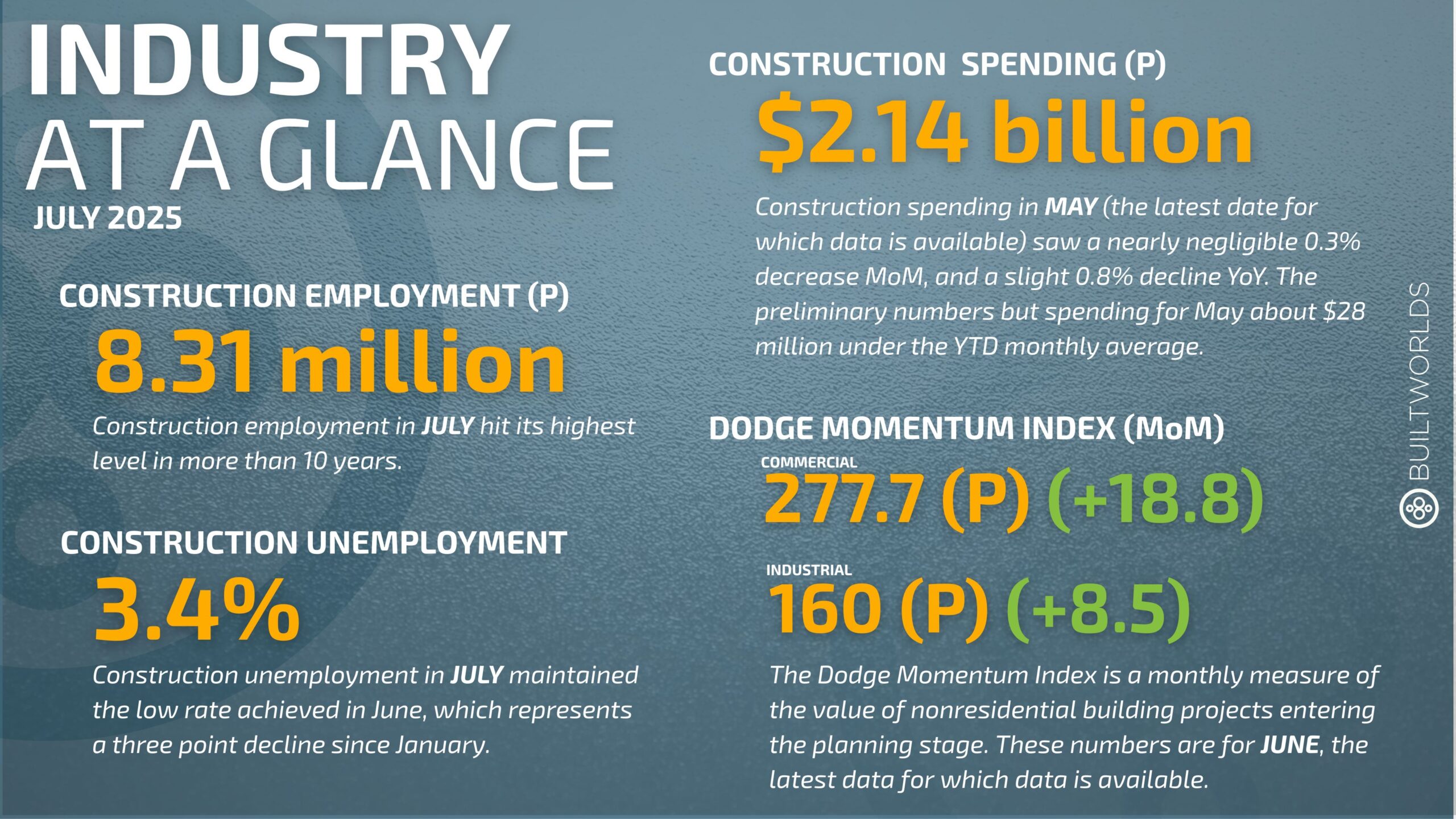
Construction employment reached an at least 10-year high in July as unemployment in the sector maintained its low 3.4% rate established in June, according to the latest figures from the U.S. Bureau of Labor Statistics.
While the rising employment in construction is widely viewed as a positive, the low unemployment rate signifies a limited labor supply. Considering the estimated 400,000+ person labor gap the industry is currently facing, the combination of high employment and low unemployment suggests the labor shortage is likely to persist. In June (the latest date for which data is available), preliminary numbers showed 249,000 current construction job openings—down 7,000 month over month (MoM) and 54,000 year over year (YoY).
Construction spending year to date (YTD) is currently out-pacing 2024, with the monthly average spend roughly $20 million higher than last year’s. However, spending in May (the latest date for which data is available) was down $7.3 million MoM and $16.6 million YoY, according to the U.S. Census Bureau.
The numbers available in July show a generally positive outlook for construction in the near-term.
Still, while the latest spending numbers are down MoM and YoY, the pipeline for future nonresidential work appears promising. In June (the latest date for which data is available), the Dodge Momentum Index (DMI)—which is released monthly and measures the value of nonresidential building projects entering the planning stage—saw increases across both the commercial and industrial construction sectors. Commercial construction’s DMI rose 18.8 points MoM and 9.9 points YoY to 277.7, while industrial construction’s DMI increased 8.5 points MoM and 42.8 points YoY.
In a statement released alongside the June DMI, Dodge Construction Network Associate Director of Forecasting Sarah Martin explained where exactly in the industry the momentum was swinging most powerfully.
“Nonresidential planning steadily improved in June, alongside strength in warehouse, recreational, and data center planning,” Martin stated. “Planning momentum in other key sectors—like education, hotels, and retail stores—was more subdued. Expectations for weaker consumer spending and travel demand, as well as volatility around funding, are likely contributing to the weaker momentum of projects entering the planning queue for those sectors.”
Discussion
Be the first to leave a comment.
You must be a member of the BuiltWorlds community to join the discussion.